[book] on earth we are briefly traumatised (I mean, gorgeous)
Monday, 5 September 2022 03:37 am![[personal profile]](https://www.dreamwidth.org/img/silk/identity/user.png) hwarium
hwariumI flicked through my copy to write this and just started crying and kept crying. He’s had such a life and each snippet bites me again.
Which is why, when the boy came to me one afternoon, the boy who would change what I knew of summer, how deep a season opens when you refuse to follow the days out of it.
I’m taking so much out of here, my notes are just ideas to steal, connections I’ve made and metaphors to write out. Not feeling at home in the country you live in, falling in love with a boy in summer, being unsure of your place in the world. Apologising for existing, taking brutality because taking is all you know. Thinking you are precious in your circle of young love until you realise the both of you carry an unconscious bias, already imposed by the world.
I thought sex was to breach new ground, despite terror, that as long as the world did not see us, its rules did not apply. But I was wrong.
The rules, they were already within us.
Taking notes because I like writing stories where it’s not just about the two people in love. Where love is complicated and messy and maybe even unkind because you were not made for it. Where you realise both of them bring baggage, and the world brings its own armchair into the house. Kind of like how Jeonghan rejects Seungcheol in Weight of Heaven despite also loving him back. It’s not that easy when life is hard.
“You’re not a monster,” I said.
But I lied.
What I really wanted to say was that a monster is not such a terrible thing to be.
…
I read that parents suffering from PTSD are more likely to hit their children. Perhaps there is a monstrous origin to it, after all. Perhaps to lay hands on your child is to prepare him for war.
to be more than a victim
What I love about Vuong is his empathy for his mother. It’s something I loved from the first time I read him. It’s such a contrast from most media that tackle intergenerational trauma. I’m side-eyeing all the creative non-fiction in university journals and a recent Disney movie that made me so mad I wrote a 6k essay about it. :’D
When does a war end? When can I say your name and have it mean only your name and not what you left behind?
I’ve grown older and I’m tired of protagonists that blame their parents for everything wrong with their lives. To summarise my complaints in the Encanto essay — I don’t like reading about protags that play the victim when they have so much more education, chances and choices compared to their parents. And when those opportunities are provided by the parents they complain about!! Feels hypocritical to blame your grandma for not ‘getting’ you when she’s the one providing the roof over your head. I prefer characters that choose to push on, be the better person despite circumstance allowing you to maintain victimhood.
To be honest, full disclosure, I used to be that teen haha. I used to love reading those kind of second-generation-immigrant stories about reclaiming your culture and bemoaning controlling families. But reading Vuong was like passing through a milestone I can never walk back to. I can never read those emo essays again because Vuong has showed me a new pinnacle. To choose to open your heart to the person that hits you and understand why they do so. To love them whole and without wanting.
It makes me think of strength. Maturity and dignity.
I also think about growth. About how, when you see how other people are so fragile and human and hurt, you start recognising that things happen to you, but they are not necessarily part of you. That its an environment you can choose to step away from and you are free to create yourself. Ah, that’s a stray thought.
two scenes
Back to Vuong. My second favourite scene was (1) when his grandmother passes away and he’s so in the moment of it, seeing death as a thing that is already in the body. But hearing her say “I used to be a girl.” :’) that made me cry. Something about remembering what people used to be always makes me cry. A difference that time has rendered bittersweet.
My favourite scene was when he told his mum he was gay. Sitting in Dunkin’ Donuts over two cups of black coffee. He gathered his courage, told her he was gay, and then she started telling him about his older brother that she aborted when she was seventeen.
When I thought it was over, that I’d done my unloading, you said, pushing your coffee aside, “Now I have something to tell you.”
My jaw clenched. This was not supposed to be an equal exchange, not a trade. I nodded as you spoke, feigning willingness.
…
We were exchanging truths, I realised, which is to say, we were cutting one another.
!!! YAH YAH YAHHHH !!!! !!! *incorrigible tantrum noises*
I love this. I love how the reciprocated honesty makes him uncomfortable and way he explains the moment. Yes absolutely I’ve been in this situation before, but I’ve never analysed and sourced it like this. It makes me think of meta-dialogue and I love meta-dialogue — when characters are communicating something beyond what they are saying. When they have unconscious reasons for saying things, when they are saying one thing but mean something else.
For me, this scene was about rejection. The narrator is coming out to his mother and he expects acknowledgment or recognition. Perhaps he had cautious hopes for acceptance, but at the very least he wanted this truth to be heard. His mum, by opening up about her history, was giving him a backhand. Like saying, ‘you have hurt me by being gay, and now I will hurt you back’. Or maybe, ‘you are not special in your pain, I’ve had it worse.’ It hurts because as a child you want to be parented, but in this moment the narrator is denied any comfort by being forced to be the comforter, and if he doesn’t offer comfort, he is automatically immoral. (Ah, reminds me of a video on unconsciously toxic traits, one of them is using pity to manipulate people into doing what you want).
Ahh! Also reminded of the pickaxe scene that I talked about from A Dictionary of Maqiao, how showing vulnerability made him feel like there was an unpaid loan between them. Because the narrator was so rawly vulnerable in front of the girl, it forced an emotional debt upon her, that she too, must show a vulnerable side to him. And that’s the human loan that can not be repaid.
what I didn’t like
Firstly, thank you to Dia for letting me call her right after tweeting about reading On Earth. I had vibes about the book but listening to her talk gave me the courage to turn those vibes into Opinions. It’s because the novel is so highly rated and publicly loved, that I wasn’t sure if it was just me being a grouchy lady reading it wrong.
The novel had many beautiful parts that I had dog-eared and tabbed, but I felt like it was lacking in cohesion, like it was a poet trying to be a novelist and falling short of all the elements that make a novel, a novel, rather than an anthology of poetic vignettes.
I finished the book feeling disappointed because I had read so much of it before, as excerpts on tumblr, as prompts on 17hols, on twitter in pictures of pages or as quotes (shout out to oceanvbot). I read A Letter to my Mother She Will Never Read on the New Yorker, which is actually Chapter 1 published as a standalone before the book was written. And that experience was so poignant it felt like Vuong reached out through the page and rewired my brain.
But as part of a novel, the first chapter felt disproportionately powerful. Like it had been rewritten and edited heavily to perfection in a way the rest of the novel was not. Like it was ambitiously dense with fifteen ideas engineered into an architecture of curated prose, and the rest of On Earth was two ideas stretched out like mozzarella over a subway footlong.
I think it’s because Vuong is a poet writing a novel, and he (or his editors) did not turn their minds to what a novel demands.
For example, poetry accepts that the reader will make an effort to absorb and digest the work. That the readers will reread lines, repeat stanzas, pause and compare and contrast and consider in utmost good faith. However, novels require the author to take the reader along the story, make links between scenes and characters, manage the momentum of the plot and the attention of the reader. The most important factor for me is to see an author laying down the bricks and building up a coherent, unified narrative.
Vuong doesn’t do that. I accept that he tries to, and for that reason I’m holding him to standards and not giving him a pass as avant-garde/post-modern fiction. He intersperses the memories of his mother and grandmother with the relationship with Trevor. I get that he’s making a point about intergenerational trauma and inheriting the wounds of your parents, but he doesn’t thread the plot-lines together. He just places them side by side and expects the reader to join the dots, and sometimes he just tells us what the connection is with a witty one-liner.
He doesn’t set up revelations over the span of the novel, or introduce an idea and develop the nuance over a series of scenes. There’s no build up, set up, or construction of any kind of foreshadowing. Ideas start and finish within 5 pages. Observation, scene, metaphor, one-liner. Repeat.
I'm not telling you a story so much as a shipwreck—the pieces floating, finally legible”
This works for poetry, but not for a novel. Even if your story is a shipwreck there still has to be plan behind how you look at the pieces. The narratology of it all felt superficial to me. His prose was more powerful on twitter, lifted and separated from the text and beautiful on its own. When I read the novel it felt like the metaphors weren’t deserved. Like he had taken the nuance of his experience for granted, told us what occurred, and slapped on a beautiful metaphor expecting us to feel what he had felt without going through the novelistic discipline of laying down the bricks of development. You just can’t write a sweeping one liner describing life because some readers will immediately think of an exception, a counter. And so the author loses integrity. A good author can make most biased statements feel true because they had set up character and made their imperfect interiority real and believable.
Another example, the repetition of monarch butterflies, “The monarchs that fly south will not make it back north. Each departure, then, is final. Only their children return; only the future revisits the past.” This wasn’t a strong motif for me because it felt like an extended simile, rather than an extended metaphor which is what you need for a theme. Scenes happen, and then Vuong makes a comparison to monarch butterflies. A comment of ’see how my life is like monarch butterflies’ and the reader must go, ‘yes I see the similarities. Whereas a metaphor would feel true without needing to make the comparison because the plot would have been set up to show how the characters struggle against the image projected. (Oh no it’s 3 am, I terminate that thought).
Last point, Dia linked me two articles before our chat and it was delicious food for thought.
When my Authentic is Your Exotic by Soniah Kamal (LitHub) (hand me down from ki - tyty)
Blunt-Force Ethnic Credibility by Som-Mai Nguyen (Astra Mag)
- This essay is absolutely brutal in the best way and shades so many ethnic writers trying to armchair preach on their culture. Keywords: diaspora essentialism and linguistic determinisation.
- TL;DR it’s the trend of pulling out tiny features of a language and then making sweeping, hyperbolic statements about the people in a culture. E.g. “ In Vietnamese, a tonal language, ma can mean many things… ghost, mother, tomb, horse, code” — followed by thesis about how similar mothers are to horses in Vietnamese culture. (jkjk that was not the example but you get the point).
- I saw this a few times in On Earth, e.g.
“In Vietnamese, the word for missing someone and remembering them is the same: nhớ. Sometimes, when you ask me over the phone, Có nhớ mẹ không? I flinch, thinking you meant, Do you remember me?
I miss you more than I remember you.”
- Foreign languages are exotic and ethnic writers often use language as a black box to generate philosophy. This part struck me as artificial, like the poetry of it was forced and retrospective. It’s similar in Chinese, “I miss you” is「我想你」which uses the character 想 [think], so lit. “I’m thinking of you.” However, there’s no ambiguity when my mum says「我想你」because of context and norms. I don’t flinch. I know what she means and Vuong probably did too. If he’s talking to his mum, he knows, logically, she did not say “do you remember me”. (But the last line still hit me like a sentient truck)
- “In repeating these careless hypotheses, individuals within (and outside) the diaspora normalize essentialism and reinforce their authority to adjudicate authenticity”
- I cheered when Ngyuyen said:“But Allen [translator] flirts with linguistic determinism to demonstrate authority, and by doing so, demonstrates that he lacks it.” YES for sure.
- I don’t mind it when someone gets excited about particulars of language, its one of the joys of learning a language (like how in Japanese, the word for lawyer contains the character for bento -> 弁護士 <- 弁当) . But then drawing conclusions based off this tiny sample of a language is (1) vainglorious and (2) tells me more about you than the language/culture/history itself.
- (Wait on reflection I don’t think I mind when someone writes this way, especially in fic because I feel like it comes from somewhere authentic. I guess it’s only when it feels inauthentic that’s it’s problematic but tHaT bRinGs uS bacK to the first article and it’s 3:30am now and I need to stop typing)
- Also this hit tweet last week:


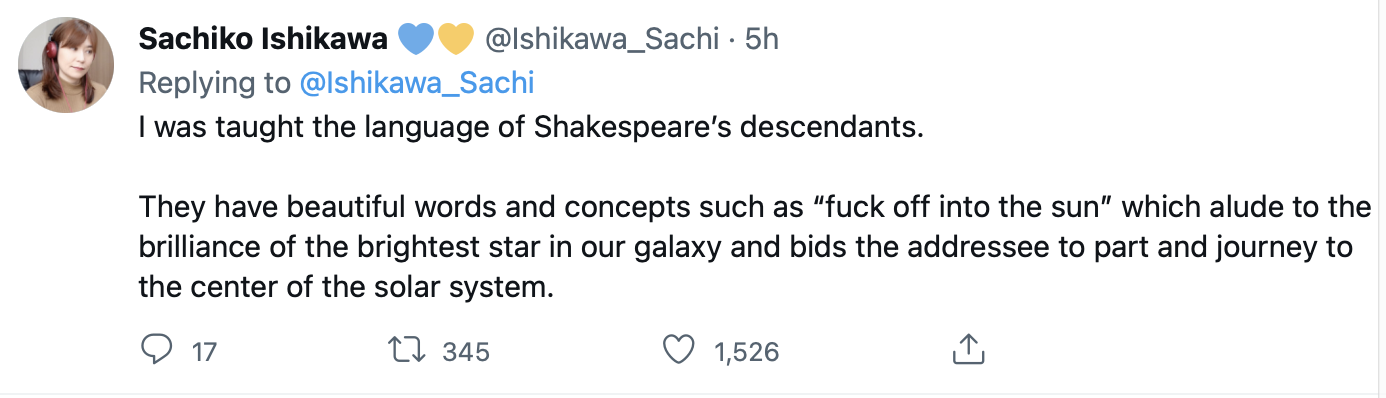
FYI here's the deleted thread
Hahaha, after so many negative thoughts I want to finish with my favourite quote because at the end of the day, Vuong is an amazing writer and I have so much more I can learn from him than I can ever attempt to criticise <3
He was a boy breaking out and into himself at once. That’s what I wanted — not merely the body, desirable as it was, but its will to grow into the very world that rejects its hunger. Then I wanted more, the scent, the atmosphere of him, the taste of french fries and peanut butter underneath the salve of his tongue, the salt around his neck from the two-hour drives to nowhere and a Burger King at the edge of the county, a day of tense talk with his old man, the rust from the electric razor he shared with that old man, how I would always find it on his sink in its sad plastic case, the tobacco, weed and cocaine on his fingers mixed with motor oil, all of it accumulating into the afterscent of wood smoke caught and soaked in his hair, as if when he came to me, his mouth wet and wanting, he came from a place on fire, a place he could never return to.
(Parts of this was edited from a reply to klav. Dia also talked about Louise Glück's American Originality and the theory that contemporary American poets are narcissists (which may apply to Vuong!!). Immediately put that book on my list I must learn more.)
If I keep writing essays every time I start thinking about a book I will never finish my half-year reading post before 2023.
no subject
Date: 5 September 2022 10:49 pm (UTC)no subject
Date: 6 September 2022 07:07 am (UTC)Also yes, after reading that nguyen article I knew it was going to be a one that I will just link all my friends, it's so good and very enlightening.
no subject
Date: 6 September 2022 05:19 am (UTC)I see what you mean about the metaphors definitely. It didn't hit me as much back then, but on reflection, the book reads a lot like a very long prose poem?
also I loved Som-Mai Nguyen's article, definitely made me think, in ways I'm not sure I can articulate, about my own work! I've tried before in the past to assign some greater meaning to my experiences when I don't think I can really say anything about a culture that isn't mine, if it ever was? sorry to navel gaze in your comments section haha
marking American Originality for later thank you, that looks really interesting
always love reading your thoughts <3
no subject
Date: 27 September 2022 02:17 am (UTC)yes the book does read like a poem, two long prose poems intersliced like ... a caprese salad? Haha that's a bad metaphor because it would imply they work well together. :'D I'm also thinking of the friction experiment we did in school where we stuck two books together just by interlocking the pages together. Like he wrote the two sections separately and just placed them side by side. (hwa is losing their touch)
Yes yes! The Nguyen article articulated things that held up a mirror to myself and my own writing (please naval gaze in my comments I love an existential chat). I think for me, I don't really mind reading about grandstanding or meaning in personal writing (like dreamwidth or fic, that's non-for profit and hobbyist, because the fact that it is read at all is a surprise/privilege/gift). And I think as we grow up, we naturally go through the stages of reflection and expression where we discover something new and get excited about it and then try to figure out how it works in the world. I really don't mind that, especially in fic, and even when the majority of korean/chinese kpop rpf isn't written by korean or chinese fans (let alone the specific segment of chinese young adult that's living in south korea. YA fiction has tried to segment and gatekeep but I'd rather not draw that line, because if you do, all it takes is to draw another line a bit further up the hill to realise how ridiculous the argument is -- wait that's a different hill to the one we are on rn HAHA)
Anyway, I've decided to reserve my opinions to when a work is done for publication, for profit, or with the aim of educating others. because that's when a standard should be placed.
(oh dear this is long, I hope you're well!)
no subject
Date: 27 October 2022 06:31 am (UTC)I'm finding the idea of just like, slicing together two books really cool? like, what a fun experiment. if you wrote something specifically for that format I think you could get so fun and metatextual (characters going "hey I'm not done with this, give me more pagetime", commentary on a "narrative" through ending things in a certain place, etc...?)
thank you for sharing re: how you think about work, I think a lot of that mirrors my own thoughts on how I think about writing. I'm not too embarassed about my essays on being mixed in college because 1. who hasn't written something navel-gaze-y in college and 2. I'm never making those more public than they already are haha.
"wait that's a different hill to the one we are on rn HAHA" we can travel to multiple hills haha
no subject
Date: 17 September 2022 02:21 am (UTC)Thank you for your words!!! As always they are so concise and make me think harder than before. A few things you said here have stayed with me: thinking about stories where love is complicated and messy and maybe even unkind because you were not made for it. Where you realise both of them bring baggage, and the world brings its own armchair into the house. (what a lovely image) and just, ...you start recognising that things happen to you, but they are not necessarily part of you. That it's an environment you can choose to step away from and you are free to create yourself. <3
I love the way you break down the "Có nhớ mẹ không?" quote, how interesting that the phrasing is similar in Chinese. Both articles you linked are added to my list (for a time when I think I am strong enough -) & thank you for mentioning American Originality and the idea that contemporary American poets are narcissists... YES. YEAH!! Holy WOW I already know I need that like air. Immediately tracking down a copy (sidenote I have acquired Dictionary of Maqiao and am excitedly awaiting time to read it) (side sidenote I emailed you Time is a Mother, please let me know if it didn't go through!)
Reading this made me feel all sorts of things. I'm sure I'll come back to this next time I think about Vuong. Thank you for sharing your thoughts!! Looking forward to potential half-year reading post *eyeball emoji* and hope you're doing well
no subject
Date: 12 October 2022 01:47 pm (UTC)Thank you for stopping by and reading my thoughts!! I hope to use those ideas in writing someday, next stage is to think about the scenes that can show a relationship like this. HM
Yess, I'm always here to listen if you read the other things and have thoughts!! Esp American Originality, that's a bit further down my reading list haha (we're getting towards the end of the year and I'm now at the stage where I'm finish all the books so I can count it for my goodreads 2022)
Nooo, I haven't received the PDF yet. Maybe I gave you the wrong email? It's hwarium (at) outlook (dot) com.
(still drafting that mid-year post HAHA please look forward to it). take care klav!!